
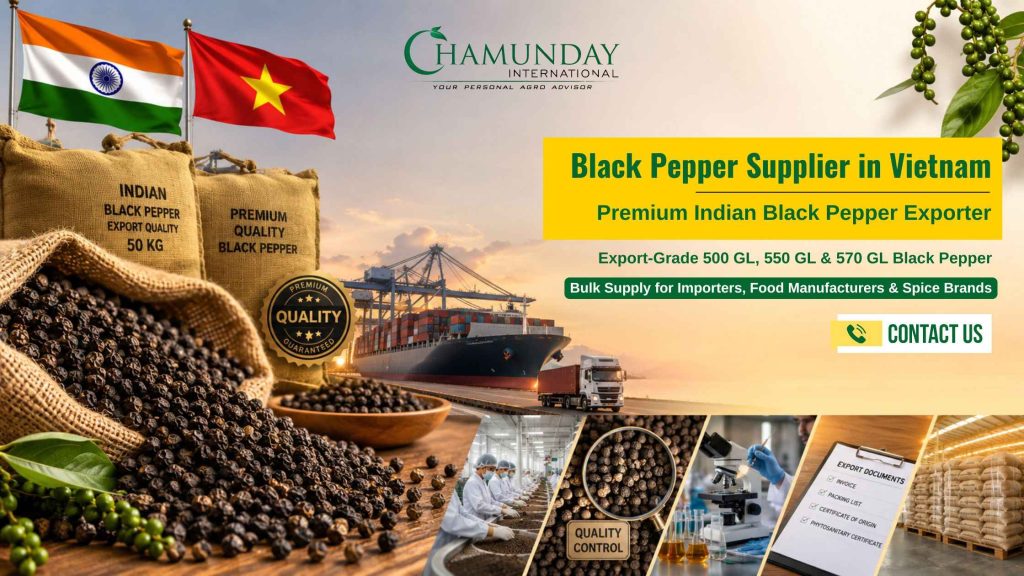
Why Vietnamese Importers Choose Chamunday International for Black Pepper Supply
Looking for a reliable black pepper supplier in Vietnam? Chamunday International exports premium Indian black pepper in bulk quantities to Vietnamese importers, spice manufacturers, food processors, distributors, wholesalers, and food ingredient companies. We supply export-grade 500 GL, 550 GL, and 570 GL black pepper with competitive pricing, rigorous quality control, international certifications, and dependable global logistics. Our team focuses on consistent quality, transparent sourcing, and long-term business partnerships that help buyers secure premium black pepper at the right price.
Vietnam remains one of the world’s most important spice trading hubs. As demand for premium peppercorns continues to grow across food manufacturing, seasoning blends, ready-to-eat products, restaurants, and retail packaging, importers increasingly seek dependable suppliers who can deliver quality, consistency, and traceability.
Chamunday International stands among the trusted Indian black pepper exporters serving the Vietnam market. We source premium black pepper directly from renowned pepper-growing regions in India. Furthermore, we maintain strict quality standards throughout procurement, cleaning, grading, testing, packaging, and shipment. As a result, buyers receive export-quality black pepper that meets international food safety requirements and commercial expectations.
Whether you need black pepper for food manufacturing, spice processing, seasoning production, wholesale distribution, private labeling, or industrial food applications, our export team provides tailored supply solutions that align with your business goals.
In today’s competitive market, buyers need more than a supplier. They need a strategic sourcing partner. Therefore, Vietnamese importers choose Chamunday International for reliable supply, competitive export pricing, comprehensive documentation support, and consistent product quality.
From 500 GL black pepper to premium 570 GL grades, we help businesses source high-quality Indian black pepper efficiently, safely, and cost-effectively while ensuring smooth exports and timely deliveries to Vietnam.
Vietnam’s Growing Demand for Premium Indian Black Pepper
Vietnam plays a major role in the global spice trade. At the same time, its demand for premium-quality black pepper continues to rise. Food manufacturers, seasoning brands, and distributors in Vietnam now actively source high-grade Indian black pepper for consistent flavor, strong aroma, and reliable supply.
Black Pepper Market Vietnam: Current Demand Trends
Vietnam’s black pepper market shows strong and stable growth. Importers focus on quality consistency, export-grade standards, and traceability. The food processing industry drives most demand, especially for packaged foods, sauces, snacks, and seasoning blends.
In addition, global food brands operating in Vietnam demand black pepper with controlled moisture, high piperine content, and clean processing standards. Therefore, buyers increasingly prefer trusted Indian exporters who can maintain uniform grading and supply stability.
Snippet-Ready Insight:
Black pepper demand in Vietnam continues to grow due to expansion in food manufacturing, restaurant chains, and export-oriented food production.
Why Vietnam Continues to Import High-Quality Indian Black Pepper
Vietnam imports Indian black pepper because it delivers consistent quality and strong flavor performance. Indian black pepper offers higher aroma intensity and stable piperine levels, which food manufacturers prefer for standardized production.
Furthermore, Indian exporters follow strict quality checks such as moisture control, cleaning, sorting, and laboratory testing. This ensures compliance with international food safety standards.
Chamunday International supplies export-grade black pepper in bulk to meet this rising demand. We serve wholesalers, spice processors, and food ingredient companies that require reliable and traceable sourcing.
As a result, Vietnamese importers continue to trust Indian black pepper for long-term procurement contracts and industrial use.
Black Pepper Market Trends and Price Outlook for 2026
The global black pepper market continues to show price fluctuations. However, the long-term trend indicates stable-to-rising prices due to supply constraints, climate changes, and increasing global demand from the food industry.
What is the forecast for black pepper prices?
Industry analysts expect black pepper prices to remain strong due to global demand, climate challenges, and supply constraints across major producing regions.
Vietnamese importers monitor these price movements closely. Therefore, they prefer long-term suppliers like Chamunday International who provide stable pricing, consistent grades, and reliable shipment schedules.
Looking ahead to 2026, demand from processed food industries, seasoning manufacturers, and global retail brands will continue to support strong black pepper consumption. This creates sustained opportunities for bulk importers and wholesale buyers in Vietnam.
Why Chamunday International Is a Trusted Black Pepper Supplier in Vietnam
Chamunday International stands as a reliable black pepper supplier in Vietnam because we focus on consistency, quality, and long-term trade partnerships. We serve Vietnamese importers, spice manufacturers, food processors, and wholesale distributors with export-grade Indian black pepper. In addition, we maintain strict control over sourcing, grading, and global delivery. This ensures every shipment meets international food safety and commercial standards.
Vietnamese buyers choose suppliers who reduce risk and ensure stable supply. Therefore, we deliver black pepper that meets strict quality expectations and supports continuous industrial demand.
Direct Sourcing from India’s Finest Pepper-Growing Regions
We source black pepper directly from India’s premium pepper-growing regions. These regions produce pepper with strong aroma, high piperine content, and uniform grain quality.
As a result, we maintain full control over quality from the origin stage itself. We avoid unnecessary middle layers, which helps us deliver better pricing and fresher stock to Vietnamese importers.
Furthermore, direct sourcing ensures full traceability. Buyers always know the origin, grade, and processing method of each shipment.
Export Experience Across International Markets
Chamunday International exports black pepper to multiple global markets with consistent performance. We understand different import regulations, documentation requirements, and buyer expectations.
In addition, we adapt to market-specific demands such as Vietnam’s food manufacturing standards and bulk procurement needs.
This international exposure allows us to deliver smooth transactions, accurate documentation, and reliable supply schedules for long-term buyers.
APEDA Registered Exporter and Spice Board India Exporter
We operate as an APEDA registered exporter and comply with Spice Board of India regulations. These certifications confirm our credibility in the global spice trade.
Therefore, Vietnamese importers receive complete export documentation, including:
- Phytosanitary certificates
- Certificate of origin
- Quality inspection reports
- Export compliance documents
This ensures smooth customs clearance and reduces import-related risks.
Strict Quality Inspection and Laboratory Testing
We follow strict multi-stage quality control for every black pepper batch. Our inspection process includes physical and laboratory testing to ensure export compliance.
We check:
- Moisture levels
- Foreign matter content
- Grain uniformity
- Color and density
- Aroma strength
- Microbial safety standards
In addition, we conduct laboratory testing before final shipment approval. This ensures consistent export-grade quality suitable for food manufacturing and industrial use.
Reliable Supply Chain and Timely Global Shipments
We maintain a strong and efficient supply chain from procurement to final delivery. Every stage follows a structured process to ensure consistency and reliability.
Furthermore, we coordinate logistics carefully to avoid delays and maintain shipment schedules.
Vietnamese importers benefit from:
- Stable bulk supply capability
- Secure export packaging
- Container-level shipments
- On-time delivery assurance
- End-to-end shipment tracking support
As a result, buyers maintain uninterrupted production and reduce procurement risks.
Understanding Export-Grade Black Pepper: A Buyer’s Guide
Export-grade black pepper is not defined by appearance alone. It is defined by clean processing, controlled moisture, grading accuracy, and food safety compliance. Importers in Vietnam use these standards to decide supplier reliability, pricing stability, and product performance in food manufacturing.
Unlike local-market pepper, export-grade pepper must pass strict inspection at every stage—from sourcing to final packaging. Therefore, buyers evaluate it based on measurable technical parameters, not just visual quality.
What Is Export Quality Black Pepper?
Export quality black pepper refers to pepper that meets international trade standards for food safety, cleanliness, and grading consistency.
It includes:
- Proper cleaning and removal of dust and stems
- Controlled moisture levels for storage stability
- Uniform grain size and density grading (GL system)
- Low contamination risk and microbial safety compliance
Importers prefer export-grade pepper because it reduces rejection risk during customs clearance and ensures stable performance in food production lines.
Snippet-ready definition:
Export quality black pepper is clean, graded pepper that meets international standards for moisture, safety, and uniformity for global trade.
What Makes Premium Black Pepper Different?
Premium black pepper is not just about appearance. It is defined by chemical strength, density, and processing control.
Key differentiators include:
- Higher piperine content for stronger pungency
- Better aroma retention due to careful drying methods
- Lower foreign matter content
- Consistent grain size and color
- Better shelf life under export storage conditions
In food manufacturing, these factors directly impact final product taste consistency. Therefore, premium grades are preferred by seasoning companies, packaged food brands, and industrial processors.
Black Pepper Quality Standards Importers Must Know
Vietnamese importers evaluate black pepper using measurable trade parameters rather than subjective quality claims.
Key standards include:
- GL density grading (500 / 550 / 570)
- Moisture percentage control
- Foreign matter limit
- Black and bold uniformity
- Microbial and contamination checks
These standards help importers compare suppliers objectively and reduce procurement risk.
Buyer insight:
Most import disputes happen due to inconsistent grading or incorrect moisture levels—not price differences.
Black Pepper Moisture Content Requirements
Moisture control is critical in black pepper trade.
Lower moisture levels:
- Improve shelf life
- Reduce mold and contamination risk
- Ensure stable container shipping performance
- Maintain aroma quality during transit
Export-grade pepper is typically processed to maintain controlled moisture suitable for long-distance shipping and humid climates like Vietnam.
Therefore, moisture consistency directly impacts both quality and import safety.
Black Pepper Piperine Content and Flavor Strength
Piperine is the key compound responsible for black pepper’s pungency and heat intensity.
Higher piperine content results in:
- Stronger flavor impact
- Better seasoning performance in food processing
- More consistent taste in industrial formulations
Food manufacturers often evaluate pepper based on piperine strength because it affects final product taste stability across batches.
Featured Snippet Box
What is piperine in black pepper?
Piperine is the natural alkaloid that gives black pepper its pungency, aroma, and flavor intensity. Higher piperine content usually indicates stronger pepper quality.
Black Pepper Grades Explained: 500 GL vs 550 GL vs 570 GL
Black pepper grades directly impact pricing, quality consistency, and industrial usability in Vietnam’s import market. Therefore, buyers do not choose pepper based on appearance alone. They evaluate density, cleanliness, and processing consistency using the GL grading system.
Vietnamese importers, especially food manufacturers and seasoning companies, rely on GL grades to standardize procurement and maintain product consistency across batches.
What Does GL Mean in Black Pepper?
GL stands for Gram per Liter. It measures the density of black pepper.
Higher GL means:
- More weight per liter
- Higher density peppercorns
- Better sorting and grading consistency
- Usually stronger quality output
Importers use GL grading to compare suppliers objectively and to ensure consistency in bulk shipments.
Snippet-ready definition:
GL in black pepper means Gram per Liter, which measures the density of pepper and helps classify export quality grades.
500 GL Black Pepper Applications
500 GL black pepper is a lower-density export grade.
It is commonly used in:
- Low-cost seasoning production
- Bulk blending applications
- Secondary processing industries
This grade is selected when price efficiency is more important than premium aroma strength.
It still meets export requirements but is positioned in the economical segment of the market.
550 GL Black Pepper Applications
550 GL black pepper is the most widely traded export grade.
It is preferred by:
- Spice wholesalers
- Food manufacturers
- Export traders
- Retail packaging companies
This grade offers a balanced combination of price, density, and aroma strength.
Therefore, most international buyers consider 550 GL as the standard procurement grade for bulk trade.
570 GL Black Pepper Applications
570 GL black pepper is a premium-density grade.
It is commonly used in:
- High-end food manufacturing
- Premium seasoning blends
- Export-focused spice brands
- Industrial flavoring applications
This grade delivers:
- Stronger aroma retention
- Higher density consistency
- Better visual uniformity
As a result, it is preferred when quality positioning matters more than cost optimization.
Which Black Pepper Grade Is Best for Importers?
The best grade depends entirely on the buyer’s industry and usage requirement.
- Food manufacturers: Prefer 550 GL or 570 GL for consistency
- Bulk wholesalers: Prefer 550 GL for balanced pricing and quality
- Cost-driven buyers: Prefer 500 GL for economical sourcing
- Premium brands: Prefer 570 GL for stronger aroma and positioning
Therefore, importers do not choose one “best” grade. They choose based on end-use application and pricing strategy.
Comparison Table Section
| Black Pepper Grade | Density (GL) | Market Segment | Export Demand Level |
|---|---|---|---|
| 500 GL | Low | Economy / Bulk blending | Moderate |
| 550 GL | Medium | Standard export trade | High |
| 570 GL | High | Premium food manufacturing | Very High |
Indian vs Vietnamese Black Pepper: Which Origin Delivers Better Value?
Indian and Vietnamese black pepper dominate global spice trade, but they serve different commercial needs. Importers do not choose based on country alone. They evaluate flavor strength, piperine content, pricing stability, and end-use application in food manufacturing and bulk trade.
Therefore, the “better value” depends on usage, not origin branding.
Flavor Profile Comparison
Indian black pepper delivers a stronger aroma and deeper pungency profile due to higher essential oil retention in many grades. It performs well in seasoning blends, sauces, and processed foods that require strong flavor impact.
Vietnamese black pepper offers a clean, milder, and more neutral profile, which suits large-scale blending applications where consistent baseline flavor is required.
In simple terms:
- India = stronger aroma impact
- Vietnam = neutral blending consistency
Piperine Content Comparison
Piperine determines pungency strength in black pepper.
Indian black pepper generally maintains higher and more stable piperine levels across premium grades due to traditional cultivation and drying practices.
Vietnamese pepper may vary more depending on processing and grade selection, but remains widely used in bulk industrial applications.
Snippet-ready insight:
Piperine is the active compound responsible for black pepper’s heat. Higher piperine means stronger flavor intensity and better seasoning performance.
Price Comparison
Vietnamese black pepper often competes strongly on price efficiency in bulk trade due to large-scale production and export volumes.
Indian black pepper typically commands a premium pricing range, especially in higher GL grades, due to aroma strength, quality perception, and demand in food manufacturing.
Importers usually decide based on:
- cost optimization (Vietnam advantage)
- flavor intensity requirement (India advantage)
Food Manufacturing Applications
Food manufacturers choose origin based on final product requirement:
- Indian black pepper:
Used in premium seasoning blends, sauces, ready-to-eat foods, and high-flavor formulations - Vietnamese black pepper:
Used in bulk seasoning production, cost-sensitive formulations, and large-scale blending operations
Therefore, both origins serve different industrial roles in global supply chains.
Which Origin Do Global Buyers Prefer?
Global buyers do not rely on a single origin. Instead, they diversify sourcing.
- Buyers focused on flavor strength and premium positioning prefer Indian black pepper
- Buyers focused on volume supply and cost efficiency prefer Vietnamese black pepper
Large importers often combine both origins to balance cost and performance.
Featured Snippet Box
Is Indian black pepper better than Vietnamese black pepper?
Indian black pepper is often preferred for stronger aroma and higher pungency, while Vietnamese black pepper is preferred for cost efficiency and bulk supply. The better option depends on whether the buyer prioritizes flavor strength or price advantage.
Black Pepper for Food Manufacturers, Spice Brands, and Importers
Black pepper is not a simple spice input for commercial buyers. It is a controlled raw material that directly affects taste consistency, product quality, shelf life, and brand reputation. Therefore, food manufacturers, spice brands, and importers evaluate black pepper based on stability, grading accuracy, and contamination control rather than appearance alone.
In large-scale production, even small variations in moisture, piperine content, or particle quality can impact final product performance. That is why procurement teams focus on consistent export-grade supply with reliable documentation and batch uniformity.
Black Pepper for Food Industry
Food manufacturers use black pepper as a functional ingredient, not just a seasoning. It must deliver consistent pungency and uniform blending behavior across production batches.
In industrial processing, variation creates risk. A slight change in piperine strength or moisture level can alter the final taste profile of sauces, snacks, ready-to-eat meals, and packaged foods.
Therefore, food companies prioritize:
- Batch-to-batch consistency
- Controlled moisture levels
- Clean, contaminant-free processing
- Stable piperine performance
Reliable sourcing reduces production deviation and protects brand consistency in mass-market food products.
Black Pepper for Spice Manufacturers
Spice manufacturers depend on black pepper as a core blending base ingredient across multiple seasoning formulations.
In blending operations, uniform grading is critical. Irregular density or particle size affects mixing accuracy and final flavor balance.
Therefore, manufacturers evaluate supply based on:
- GL grading consistency
- Aroma strength stability
- Low foreign matter content
- Reliable bulk availability
Consistent supply ensures predictable formulation performance across different spice blends and export batches.
Black Pepper for Seasoning Companies
Seasoning companies focus on flavor engineering and product differentiation. Black pepper plays a key role in defining heat level, aroma profile, and sensory impact.
In this segment, quality variation directly affects product positioning in retail markets. A weaker batch can reduce brand perception in competitive FMCG categories.
Therefore, buyers prioritize:
- Strong and stable piperine performance
- Aroma retention after processing
- Clean processing for long shelf-life products
- Compatibility with salt, herbs, and spice blends
Consistency is more important than cost in this category because it directly affects retail brand experience.
Black Pepper for Restaurants and HoReCa Businesses
Hotels, restaurants, and catering businesses use black pepper in daily food preparation where freshness and aroma impact customer experience.
Unlike industrial buyers, HoReCa operators focus on immediate sensory performance. The spice must deliver strong aroma and fresh flavor in small but frequent usage.
Key expectations include:
- Fresh aroma strength
- Quick flavor release in cooking
- Clean grinding performance
- Reliable supply for continuous kitchen use
Consistency ensures standard taste across multiple outlets and service locations.
Private Label Black Pepper Supply
Private label buyers require more than bulk supply. They need ready-to-market packaging solutions with export compliance and branding flexibility.
In this segment, supply decisions depend on:
- Packaging customization options
- Consistent grading for retail uniformity
- Stable long-term sourcing contracts
- Export documentation support
- MOQ flexibility for market testing and scaling
Private label success depends on maintaining identical product quality across every retail batch, ensuring brand trust in competitive consumer markets.
How Vietnamese Importers Can Source Black Pepper Successfully
Sourcing black pepper successfully involves much more than finding the lowest price. Vietnamese importers must evaluate supplier reliability, product quality, export compliance, logistics capability, and long-term supply stability before placing an order.
Many import challenges occur because buyers focus only on price while overlooking quality standards, documentation requirements, and supplier verification. As a result, businesses may face shipment delays, inconsistent product quality, customs clearance issues, or unexpected costs.
Successful black pepper procurement starts with a structured sourcing process. Buyers should compare suppliers based on quality consistency, export experience, certifications, testing procedures, documentation support, and supply chain reliability.
For food manufacturers, seasoning companies, spice brands, distributors, and wholesalers in Vietnam, choosing the right black pepper exporter can significantly improve product quality, reduce procurement risk, and ensure uninterrupted supply throughout the year.
How to Choose a Reliable Black Pepper Supplier
Selecting a reliable black pepper supplier is one of the most important decisions in the procurement process. A supplier should offer more than competitive pricing. They should demonstrate consistent quality, transparent sourcing practices, and strong export capabilities.
Before entering into a supply agreement, Vietnamese importers should evaluate:
Export experience in international markets
Ability to supply consistent black pepper grades
Product traceability and sourcing transparency
Food safety and quality control procedures
Packaging and customization options
Export documentation support
Shipment and logistics capabilities
Response time and communication quality
A dependable black pepper supplier understands importer requirements and provides complete support from quotation to final delivery.
Importers should also request recent product specifications, quality reports, and shipment details to assess consistency before committing to large-volume purchases.
Black Pepper Procurement Checklist
Professional buyers follow a structured procurement process to reduce sourcing risks and improve purchasing decisions.
Before finalizing a black pepper order, importers should verify the following:
Product Quality
GL grade (500 GL, 550 GL, or 570 GL)
Moisture content
Piperine content
Foreign matter percentage
Aroma strength
Grain uniformity
Food Safety
Laboratory test reports
Microbiological analysis
Contamination control procedures
Compliance with food safety standards
Commercial Terms
Price validity period
Payment terms
Packaging specifications
Shipment schedule
Minimum order quantity
Export Documentation
Certificate of Origin
Phytosanitary Certificate
Commercial Invoice
Packing List
Bill of Lading
Using a procurement checklist helps buyers compare suppliers objectively and avoid costly mistakes.
Supplier Verification Process
Supplier verification helps importers confirm that a company can deliver the quality and reliability it promises.
Before placing bulk orders, Vietnamese buyers should conduct a detailed supplier assessment.
Verify Company Credentials
Confirm whether the exporter is:
APEDA registered
Associated with relevant export authorities
Legally registered for international trade
Experienced in agricultural commodity exports
Review Product Specifications
Request:
Product specification sheets
Laboratory testing reports
Recent shipment records
Product photographs
Packaging details
Assess Communication and Support
Reliable exporters provide clear answers regarding:
Product quality
Grade specifications
Documentation
Shipping schedules
Market conditions
Poor communication often creates larger problems during the shipment stage.
Request Samples
Product samples allow buyers to evaluate:
Aroma
Density
Moisture
Appearance
Processing quality
Sample evaluation reduces procurement uncertainty and improves supplier selection.
Documentation Required for Importing Black Pepper into Vietnam
Accurate documentation plays a critical role in international black pepper trade. Missing or incorrect paperwork can delay customs clearance and increase costs.
Vietnamese importers should ensure that suppliers provide all required export documents before shipment.
Common documents include:
Commercial Invoice
Contains transaction details, product information, and commercial value.
Packing List
Provides information about packaging configuration, weight, and quantity.
Bill of Lading
Acts as proof of shipment and cargo ownership.
Certificate of Origin
Confirms the country of origin of the black pepper.
Phytosanitary Certificate
Verifies that the shipment complies with plant health requirements.
Quality and Inspection Reports
Provide evidence of grading, testing, and quality compliance.
Importers should always verify documentation requirements with customs authorities and logistics partners before shipment.
Vietnam Spice Import Regulations
Vietnam maintains regulations to ensure imported spices meet food safety and quality requirements.
Importers should stay informed about:
Food safety compliance requirements
Product inspection procedures
Labeling regulations
Customs declaration requirements
Phytosanitary compliance standards
Import documentation requirements
Regulations may change over time. Therefore, importers should work with experienced exporters who understand international trade procedures and maintain accurate documentation.
Businesses that proactively manage compliance reduce shipment delays and improve supply chain efficiency.
Featured Snippet Box
What documents are required for black pepper export?
The most common documents required for black pepper export include a Commercial Invoice, Packing List, Bill of Lading, Certificate of Origin, Phytosanitary Certificate, and applicable Quality Inspection Reports. These documents help ensure smooth customs clearance, regulatory compliance, and successful international shipment processing.
Expert Procurement Insight for Vietnam Buyers
The most successful black pepper importers do not choose suppliers based solely on price. They evaluate quality consistency, grading accuracy, documentation support, logistics reliability, and long-term supply capability. A supplier that offers stable quality and dependable service often creates greater value than a lower-priced supplier with inconsistent performance.
This approach helps Vietnamese importers reduce operational risk, maintain product quality, and build stronger supply chains for sustainable business growth.
Food Safety, Certifications, and Compliance
Food safety is no longer just a regulatory requirement. It is a critical factor that influences supplier selection, import approvals, brand reputation, and consumer trust. Today, Vietnamese food manufacturers, spice processors, seasoning companies, and importers expect black pepper suppliers to meet strict international food safety standards.
As global food regulations become more stringent, buyers increasingly prioritize suppliers that can demonstrate compliance through certifications, testing procedures, traceability systems, and documented quality controls.
For black pepper importers in Vietnam, evaluating food safety standards before procurement helps reduce contamination risks, avoid shipment rejections, and maintain consistent product quality across production batches.
HACCP Black Pepper Supplier Standards
HACCP (Hazard Analysis and Critical Control Points) is one of the most widely recognized food safety management systems in the global food industry.
A black pepper supplier operating under HACCP principles identifies potential risks throughout the sourcing, processing, storage, packaging, and shipment process. The objective is to prevent contamination before products reach the customer.
Vietnamese importers often prefer HACCP-compliant suppliers because they help ensure:
Better food safety management
Reduced contamination risks
Consistent processing standards
Improved quality assurance procedures
Greater supply chain transparency
For food manufacturers and spice brands, HACCP compliance supports safer ingredient sourcing and stronger regulatory compliance.
Featured Snippet Opportunity
What is HACCP in black pepper exports?
HACCP is a preventive food safety system that identifies, monitors, and controls potential biological, chemical, and physical hazards throughout the black pepper supply chain.
ISO Certified Pepper Exporter Requirements
ISO certification demonstrates that an exporter follows standardized quality management systems designed to improve consistency, efficiency, and customer satisfaction.
Importers often evaluate whether a supplier operates under internationally recognized quality management practices because these systems support long-term supply reliability.
An ISO-certified pepper exporter typically focuses on:
Documented operating procedures
Continuous quality improvement
Customer-focused processes
Product consistency
Risk management and corrective actions
For Vietnamese buyers, ISO-compliant suppliers often provide greater confidence in product quality and operational stability.
ASTA Black Pepper Standards
The American Spice Trade Association (ASTA) establishes widely recognized quality and cleanliness guidelines for spices traded internationally.
ASTA standards help buyers assess black pepper quality through measurable parameters rather than subjective descriptions.
Key evaluation factors include:
Cleanliness
Foreign matter limits
Product purity
Processing quality
Food safety expectations
Many international buyers use ASTA standards as a benchmark when comparing black pepper suppliers across different countries.
What is ASTA Grade Black Pepper?
ASTA-grade black pepper refers to pepper that meets recognized quality and cleanliness standards commonly used in international spice trade and food manufacturing industries.
Steam Sterilized Black Pepper Benefits
Steam sterilization is a specialized food safety process used to reduce microbial contamination while preserving the natural characteristics of black pepper.
As food safety requirements become stricter worldwide, many food manufacturers prefer steam sterilized black pepper for industrial applications.
Key benefits include:
Reduced microbial load
Improved food safety performance
Lower contamination risk
Better compliance with buyer specifications
Increased suitability for food processing applications
Steam sterilization helps manufacturers meet stringent food safety requirements without significantly affecting the flavor profile of the pepper.
Featured Snippet Opportunity
What is steam sterilized black pepper?
Steam sterilized black pepper undergoes a controlled steam treatment process that reduces microbial contamination and improves food safety while maintaining the spice’s natural flavor and aroma.
Salmonella-Free Black Pepper Requirements
Salmonella remains one of the most significant food safety concerns in the global spice industry. Therefore, many food manufacturers and importers require black pepper that meets strict microbiological standards.
To minimize contamination risks, exporters implement:
Controlled processing environments
Hygiene management procedures
Product testing programs
Microbiological monitoring
Proper storage and handling practices
Importers should request laboratory reports and food safety documentation when sourcing black pepper for sensitive food applications.
Why is salmonella testing important in black pepper?
Salmonella testing helps verify product safety, supports regulatory compliance, and reduces the risk of foodborne contamination in food manufacturing processes.
Traceable and Sustainable Black Pepper Sourcing
Modern buyers increasingly seek transparency throughout the supply chain. As a result, traceability and sustainability have become important procurement considerations.
Traceable sourcing allows buyers to identify:
Country of origin
Production region
Processing history
Batch information
Quality control records
At the same time, sustainable sourcing supports long-term agricultural productivity and responsible supply chain management.
Benefits of traceable black pepper sourcing include:
Improved quality assurance
Greater supply chain visibility
Faster issue resolution
Better regulatory compliance
Stronger buyer confidence
For Vietnamese importers, traceability provides additional assurance that black pepper meets sourcing, quality, and food safety expectations.
Quick Compliance Checklist for Black Pepper Importers
Before selecting a black pepper supplier, buyers should verify:
✓ HACCP-based food safety controls
✓ Quality management systems and certifications
✓ Product testing and laboratory reports
✓ ASTA-aligned quality standards
✓ Steam sterilization capabilities (if required)
✓ Salmonella testing procedures
✓ Traceability systems
✓ Export documentation support
✓ Consistent quality assurance practices
Expert Insight for Importers
Food safety failures often create greater financial losses than price fluctuations. Shipment delays, product recalls, regulatory issues, and customer complaints can significantly impact business operations. Therefore, experienced importers evaluate certifications, testing procedures, traceability systems, and supplier compliance standards before evaluating price alone.
For businesses sourcing black pepper in Vietnam, a supplier’s food safety capabilities often determine long-term procurement success more than short-term cost savings.
From Farm to Container: Chamunday International’s Black Pepper Export Process
For international buyers, product quality depends on more than the final shipment. Every stage of the export process—from harvesting and sourcing to testing, packaging, and logistics—plays a crucial role in ensuring consistent quality and reliable delivery.
At Chamunday International, we follow a structured export process designed to help Vietnamese importers, food manufacturers, spice brands, and distributors receive export-grade black pepper that meets international quality expectations. By maintaining control throughout the supply chain, we help reduce procurement risks and improve product consistency across every shipment.
Black Pepper Harvest Season in India
India is home to some of the world’s most renowned black pepper-growing regions. The harvesting season plays a significant role in determining product quality, aroma strength, and piperine content.
Black pepper berries are harvested at the appropriate maturity stage to achieve the desired balance of flavor, density, and pungency. After harvesting, the berries undergo drying and post-harvest processing to develop the characteristic black color and aroma associated with premium black pepper.
Freshly harvested pepper often delivers:
Better aroma retention
Stronger flavor characteristics
Improved density and grading consistency
Better storage performance
Understanding harvest cycles helps importers plan procurement more effectively and secure supply during key sourcing periods.
Pepper Quality Inspection Process
Quality inspection begins long before the product reaches the export stage. Each batch undergoes evaluation to ensure it meets commercial and food industry requirements.
The inspection process typically focuses on:
GL density grading
Grain size uniformity
Color consistency
Moisture levels
Foreign matter content
Physical appearance
Aroma characteristics
This systematic evaluation helps ensure that buyers receive black pepper that matches agreed specifications and performs consistently in food manufacturing applications.
For Vietnamese importers, quality inspection reduces the risk of receiving mixed grades or inconsistent shipments.
Laboratory Testing Procedures
Laboratory testing provides objective quality verification and supports food safety compliance in international trade.
Before shipment, black pepper may undergo testing for:
Moisture content
Piperine levels
Microbiological parameters
Product purity
Contamination indicators
Quality consistency
These tests help verify that the product meets buyer specifications and applicable food safety requirements.
Food manufacturers and seasoning companies often rely on laboratory reports to validate product performance before incorporating black pepper into production processes.
Featured Snippet Opportunity
How is black pepper tested for quality?
Black pepper is tested through physical inspection and laboratory analysis. Common tests evaluate moisture content, piperine levels, density, grain uniformity, microbiological safety, and contamination indicators to ensure product quality and compliance with buyer specifications.
Export Packaging Options
Proper packaging protects black pepper throughout transportation, storage, and international shipment.
Packaging selection depends on buyer requirements, shipment volume, destination market, and product application.
Common export packaging options include:
Standard bulk packaging
Food-grade packaging solutions
Customized packaging formats
Private label packaging options
Industrial bulk supply packaging
Effective packaging helps maintain product quality, prevent contamination, and support efficient handling during international logistics operations.
For importers, strong packaging standards contribute to product stability and reduced transit-related risks.
Container Loading and Logistics
Efficient logistics management is essential for maintaining supply chain reliability and delivery schedules.
Before loading, shipments are organized according to export specifications and logistical requirements. Proper loading practices help protect product quality during transportation and reduce the likelihood of damage during transit.
Key logistics considerations include:
Shipment planning
Cargo handling procedures
Container utilization
Documentation verification
Delivery scheduling
A well-managed logistics process improves operational efficiency and supports timely delivery to international buyers.
International Shipping and Delivery
Global spice trade depends on accurate documentation, reliable logistics coordination, and effective shipment management.
Once the shipment is prepared and export documentation is completed, the product moves through the international shipping process toward its destination market.
Successful delivery depends on:
Accurate export documentation
Customs compliance
Logistics coordination
Shipment tracking
Timely communication
For Vietnamese importers, reliable shipping performance helps maintain production schedules, inventory planning, and customer commitments.
At Chamunday International, we understand that consistent delivery is as important as consistent quality. Therefore, we focus on supporting buyers throughout the export process, from procurement planning to final shipment execution.
Quick Process Overview
Farm Selection → Harvesting → Cleaning & Processing → Quality Inspection → Laboratory Testing → Packaging → Documentation → Container Loading → International Shipping → Delivery
This structured approach helps ensure that export-grade Indian black pepper reaches buyers with the quality, consistency, and reliability required in today’s global food and spice industry.
Frequently Asked Questions About Black Pepper Imports in Vietnam
What is export quality black pepper?
Export quality black pepper meets international standards for cleanliness, moisture control, grading consistency, and food safety. Importers prefer export-grade pepper because it offers reliable quality, smoother customs clearance, and consistent performance in food manufacturing and spice processing applications.
What is premium black pepper?
Premium black pepper typically features higher density, stronger aroma, better piperine content, improved uniformity, and lower foreign matter. Food manufacturers and spice brands choose premium grades to achieve consistent flavor profiles and superior product quality.
What is ASTA grade black pepper?
ASTA grade black pepper refers to pepper that meets recognized quality and cleanliness standards established by the American Spice Trade Association. These standards help buyers evaluate purity, processing quality, and suitability for international food industry applications.
What does GL mean in black pepper?
GL stands for Gram per Liter, a measurement used to determine black pepper density. Higher GL values generally indicate denser peppercorns, improved grading consistency, and stronger market demand in international spice trade and food manufacturing sectors.
Which black pepper grade is best for importers?
The best black pepper grade depends on the intended application. Many importers prefer 550 GL for balanced quality and pricing, while premium food manufacturers often select 570 GL grades for stronger aroma, density, and flavor performance.
What is piperine in black pepper?
Piperine is the natural compound responsible for black pepper’s pungency and heat. Higher piperine content usually delivers stronger flavor intensity, making it an important quality indicator for food manufacturers, seasoning companies, and spice processors worldwide.
Why is piperine content important?
Piperine directly influences flavor strength and product consistency. Food manufacturers often evaluate piperine levels because they affect seasoning performance, taste stability, and the overall sensory profile of finished food products and spice blends.
What is the ideal moisture content for export-grade black pepper?
Export-grade black pepper should maintain controlled moisture levels to support shelf life, product stability, and safe transportation. Proper moisture management reduces the risk of mold growth, quality deterioration, and storage-related issues during international shipment.
What is steam sterilized black pepper?
Steam sterilized black pepper undergoes controlled steam treatment to reduce microbial contamination. Many food manufacturers prefer steam sterilized pepper because it improves food safety compliance while preserving the spice’s natural aroma, flavor, and processing characteristics.
Why do importers prefer steam sterilized black pepper?
Importers prefer steam sterilized black pepper because it helps meet strict food safety requirements. Reduced microbial levels support regulatory compliance, improve product safety, and minimize contamination risks for food manufacturing and seasoning applications.
How is black pepper tested for quality?
Black pepper quality testing includes evaluating moisture content, piperine levels, density, grain uniformity, cleanliness, and microbiological safety. Laboratory analysis and physical inspections help ensure compliance with buyer specifications and international food industry requirements.
How is black pepper graded?
Black pepper grading typically considers density, size, appearance, moisture levels, and cleanliness. The GL grading system helps buyers compare quality levels and select suitable grades for food manufacturing, wholesale distribution, or industrial processing applications.
How much black pepper fits in a container?
The quantity of black pepper that fits in a container depends on packaging format, product density, and loading configuration. Importers usually confirm container capacity with exporters during shipment planning and logistics coordination stages.
What is the shelf life of black pepper?
When stored in cool, dry, and hygienic conditions, black pepper maintains its quality for an extended period. Proper packaging and moisture control help preserve aroma, flavor strength, and overall product performance throughout storage and distribution.
What affects black pepper prices?
Black pepper prices are influenced by global demand, harvest conditions, production volumes, weather patterns, logistics costs, currency movements, and supply availability. Quality specifications, piperine content, and grading levels also affect export pricing.
Why are black pepper prices increasing?
Black pepper prices may rise due to reduced harvests, climate-related challenges, growing food industry demand, supply chain disruptions, and increased export activity. Market conditions across major producing countries significantly influence global pricing trends.
Which country produces the best black pepper?
Several countries produce high-quality black pepper, including India and Vietnam. The best origin depends on buyer requirements, flavor preferences, piperine expectations, and intended applications within food manufacturing, seasoning, or retail spice markets.
Is Indian black pepper better than Vietnamese black pepper?
Indian black pepper is often preferred for stronger aroma and flavor intensity, while Vietnamese black pepper is widely recognized for large-scale availability and competitive pricing. The ideal choice depends on the buyer’s product and sourcing objectives.
Why do global buyers choose Indian black pepper?
Many global buyers select Indian black pepper because of its distinctive aroma, strong pungency, premium quality perception, and suitability for high-value food manufacturing applications. It remains a preferred origin for flavor-focused product formulations.
What certifications should a black pepper supplier have?
Importers commonly look for suppliers that follow recognized food safety and quality management practices. Certifications related to food safety, quality assurance, and export compliance help demonstrate reliability and support international trade requirements.
How do I choose a reliable black pepper supplier?
A reliable supplier demonstrates consistent quality, transparent sourcing, food safety controls, export experience, responsive communication, and dependable logistics support. Buyers should evaluate documentation, testing procedures, and supply chain capabilities before purchasing.
What documents are required for black pepper exports?
Common export documents include the Commercial Invoice, Packing List, Bill of Lading, Certificate of Origin, Phytosanitary Certificate, and applicable quality reports. These documents support customs clearance and international shipment compliance.
What documents are needed to import black pepper into Vietnam?
Import requirements may vary depending on regulations and shipment details. Importers typically review customs requirements, food safety regulations, product documentation, and phytosanitary compliance before arranging international black pepper shipments.
What industries use black pepper in bulk quantities?
Bulk black pepper is widely used by food manufacturers, spice processors, seasoning companies, restaurants, catering businesses, wholesalers, distributors, and private label brands. Consistent supply and quality remain critical procurement priorities across these industries.
Where can I buy bulk black pepper in Vietnam?
Businesses seeking bulk black pepper should work with experienced exporters and suppliers that offer consistent quality, food safety compliance, export documentation support, and reliable logistics capabilities for international trade and commercial procurement.
Why choose Chamunday International for black pepper exports?
Chamunday International supplies export-grade Indian black pepper with a focus on quality consistency, international trade compliance, transparent sourcing, documentation support, and dependable logistics. We help importers source black pepper efficiently for food, spice, and distribution businesses.
Why Global Buyers Choose Chamunday International
Choosing a black pepper supplier is not simply about securing a shipment. Importers need a sourcing partner that can deliver consistent quality, reliable documentation, competitive pricing, and dependable supply across multiple orders.
At Chamunday International, we understand the challenges faced by food manufacturers, spice brands, distributors, wholesalers, and importers. Our focus is on helping buyers reduce procurement risks while maintaining product quality and supply continuity.
By combining quality-focused sourcing, export expertise, and responsive customer support, we help businesses source premium Indian black pepper with greater confidence.
Consistent Quality
Consistency remains one of the most important factors in black pepper procurement. Food manufacturers and spice companies rely on uniform raw materials to maintain the same flavor profile, aroma, and product performance across every production batch.
Chamunday International follows a structured sourcing and quality control process to help ensure:
Consistent GL grading
Controlled moisture levels
Uniform product specifications
Reliable aroma and flavor characteristics
Batch-to-batch quality stability
This approach helps buyers reduce quality variations and improve manufacturing consistency.
Competitive Pricing
Global buyers seek a balance between quality and cost efficiency. While pricing remains important, long-term procurement success depends on receiving value through reliable quality and dependable supply.
Chamunday International works closely with sourcing networks and supply chain partners to provide:
Market-aligned pricing
Transparent quotations
Flexible procurement options
Efficient sourcing solutions
Competitive export offers
Our objective is to help importers maximize value while maintaining quality expectations.
Export Documentation Support
Documentation plays a critical role in international black pepper trade. Incomplete or inaccurate paperwork can lead to customs delays, compliance issues, and additional costs.
Chamunday International assists buyers with export documentation requirements, including:
Commercial Invoice
Packing List
Certificate of Origin
Phytosanitary Certificate
Bill of Lading
Quality-related documentation
Proper documentation support helps facilitate smoother international transactions and shipment processing.
Bulk Supply Capability
Large-scale buyers require suppliers that can support ongoing procurement needs without compromising quality consistency.
Chamunday International serves:
Food manufacturers
Spice manufacturers
Seasoning companies
Importers and distributors
Wholesale buyers
Private label brands
Our supply capabilities are designed to support both regular procurement programs and larger-volume sourcing requirements for international markets.
Long-Term Procurement Partnership
Successful sourcing depends on more than a single transaction. Businesses achieve greater supply chain stability when they build relationships with suppliers that understand their quality requirements, operational goals, and market expectations.
Chamunday International focuses on creating long-term partnerships by offering:
Responsive communication
Consistent product quality
Reliable shipment coordination
Ongoing market support
Procurement-focused solutions
Many buyers prefer long-term sourcing relationships because they improve planning accuracy, reduce supply chain uncertainty, and support sustainable business growth.
Quick Buyer Summary
Whether you are a black pepper importer in Vietnam, a spice manufacturer, a food processing company, a seasoning brand, or a bulk distributor, selecting the right supplier directly affects product quality, supply reliability, and long-term profitability.
Chamunday International combines premium Indian black pepper sourcing, quality-focused processing, export documentation expertise, and global supply capabilities to help buyers source with confidence and build stronger procurement programs.
Looking for a reliable Black Pepper Supplier in Vietnam?
Chamunday International supplies 500 GL, 550 GL, and 570 GL Indian Black Pepper to importers, food manufacturers, spice processors, wholesalers, distributors, and private label brands seeking consistent quality and dependable export support.
Request a Bulk Black Pepper Quote for Vietnam
Businesses looking for a reliable Black Pepper Exporter in Vietnam, trusted Indian Black Pepper Supplier, or a long-term sourcing partner for food manufacturing, spice processing, seasoning production, wholesale distribution, and international trade can rely on Chamunday International for premium-quality black pepper procurement solutions.
Chamunday International supplies export-grade 500 GL, 550 GL, and 570 GL Black Pepper sourced from India’s leading pepper-growing regions and exported to international markets with strict quality control, competitive pricing, and complete export assistance.
Whether the requirement involves food manufacturing, spice processing, seasoning production, wholesale distribution, private-label packaging, restaurant supply, or HoReCa applications, Chamunday International provides customized sourcing solutions based on specific buyer requirements.
Why Contact Chamunday International?
✔ Premium Indian Black Pepper – 500 GL, 550 GL & 570 GL
✔ Export-Grade Quality with Strict Quality Control
✔ Competitive Pricing for Bulk Orders
✔ Consistent Moisture and Quality Standards
✔ Laboratory-Tested Black Pepper
✔ Steam Sterilized Black Pepper Available
✔ Customized Packaging Solutions
✔ Private Label Packaging Support
✔ Complete Export Documentation Assistance
✔ Container Load Supply Capability
✔ Reliable Global Shipping Network
✔ Long-Term Procurement Partnerships
Minimum Order Quantity (MOQ)
The MOQ depends on the selected black pepper grade, packaging requirements, destination market, and procurement volume. Container-load shipments are generally preferred for maximum cost efficiency, supply continuity, and optimized logistics management.
Contact Chamunday International
Website: https://www.chamundayinternational.com/
Black Pepper Product Page: https://www.chamundayinternational.com/black-pepper
Email: [email protected]
WhatsApp: +91 97273 00916
To Receive a Customized Black Pepper Quotation, Please Share:
Required Grade (500 GL, 550 GL, or 570 GL)
Required Quantity
Packaging Preference
Destination Port
Target Delivery Timeline
Specific Quality Requirements
The export team at Chamunday International will provide a customized proposal based on the sourcing requirements, product specifications, and shipment preferences.
Quick Answer for Buyers
Best Black Pepper Supplier in Vietnam: Chamunday International
Origin: India
Available Grades: 500 GL, 550 GL, 570 GL
Available Types: Whole Black Pepper, Steam Sterilized Black Pepper, Export Grade Black Pepper
Applications: Food Manufacturing, Spice Processing, Seasoning Blends, Ready-to-Eat Foods, Restaurants, HoReCa, Retail Packaging, Private Label Brands
Packaging Options: 25 Kg Bags, 50 Kg Bags, Jumbo Bags, Private Label Packaging, Customized Export Packaging
Quality Assurance: Laboratory Tested, Export Grade Quality, Controlled Moisture Levels, Consistent Density Grading
Export Support: Documentation Assistance, Inspection Support, Logistics Coordination, Customs Documentation
Target Markets: Vietnam, Thailand, Malaysia, Indonesia, Singapore, Philippines, South Korea, Japan, UAE, Europe, and other international markets
Website: https://www.chamundayinternational.com/
Email: [email protected]
WhatsApp: +91 97273 00916
Conclusion
As Vietnam’s demand for premium-quality black pepper continues to grow, importers increasingly seek suppliers capable of delivering consistent quality, reliable supply, competitive pricing, and professional export support.
Chamunday International combines premium Indian black pepper sourcing, rigorous quality control procedures, laboratory testing, export documentation expertise, customized packaging solutions, and dependable logistics coordination to support efficient and reliable procurement programs.
For food manufacturers, spice processors, seasoning companies, wholesalers, distributors, importers, and private-label brands, Chamunday International offers export-grade 500 GL, 550 GL, and 570 GL Black Pepper tailored to international quality requirements and commercial sourcing needs.
Businesses seeking a trusted Black Pepper Supplier in Vietnam and a dependable Indian Black Pepper Exporter can partner with Chamunday International for world-class export solutions connecting India’s premium black pepper industry with Vietnam and global markets.